Amazon Leadership Principles STAR Method Examples (2026 Guide)
Master the STAR method for Amazon's behavioral rounds. Learn how to draft high-scoring stories, thread multiple principles, and impress the Bar Raiser

High scoring STAR method examples for Amazon leadership principles 2026 rely on extreme detail, metric-driven results, and clear individual ownership. To pass Amazon's intense behavioral loop, your Situation, Task, Action, and Result (STAR) stories must prove you operate at their specific leadership bar. Vague summaries and collective team accomplishments will lead to an immediate rejection.
The Anatomy of a High Scoring Amazon STAR Story
Amazon is a data-driven machine. They do not care about your general career philosophy. They care about what you specifically decided, how you measured the problem, and the concrete metrics you achieved.
This is why generic behavioral answers collapse in Amazon loops. You must structure every story using the STAR method Amazon LP answers examples template:
Situation (10 percent of time): State the company, the scale, and the clear business problem. Keep it under three sentences.
Task (10 percent of time): Define the exact goal you were assigned or the problem you took upon yourself to solve.
Action (60 percent of time): Explain the precise steps you took. Use "I" instead of "we" constantly. Proving individual contribution is the only way to earn points.
Result (20 percent of time): State the business outcome. You must include concrete, quantified metrics (percentage improvements, dollars saved, hours recovered).
If your story lacks numbers, it is not a story; it is a placeholder. Amazon interviewers will drill into the Action and Result phases with relentless follow-up questions.
Amazon Customer Obsession STAR Answer Example
Customer Obsession is the first and most critical Leadership Principle. Amazon expects you to start with the customer and work backward. Here is a high-scoring STAR response for an engineering candidate:
Situation
During my time at a fintech startup, our primary Stripe payment gateway integration experienced intermittent HTTP 504 gateway timeout failures during peak Friday traffic. This issue impacted roughly three percent of our active checkout sessions, leading to customer support ticket spikes and immediate revenue leakage.
Task
As the Lead Backend Engineer, I had to identify the root cause, restore API transaction reliability, and implement a long-term fix without disrupting active customer sessions.
Action
I bypassed the standard weekly release schedule to deploy a targeted connection pool monitor on our Express.js backend. I analyzed PostgreSQL database transaction logs over a four-hour window and discovered a connection pool exhaustion issue where the pg-pool library was maxing out its twenty-connection limit under high concurrency. I modified the database connection parameters in our AWS RDS settings, raising the max pool size to eighty, and refactored our Redis query caching layer to intercept read-heavy balance checks, which decreased active database load by forty percent. I also built a custom fallback router with exponential backoff retry logic. Throughout the weekend, I provided our customer support lead with system status updates every two hours so they could communicate transparently with affected users.
Result
The payment gateway achieved one hundred percent uptime during the subsequent peak traffic periods. API transaction failure rates dropped to zero percent, and our customer support ticket volume regarding payment issues fell by eighty-five percent. This action preserved approximately forty thousand dollars in weekly transaction revenue.
This is a prime Amazon customer obsession STAR answer example because it showcases proactive communication, immediate action, and clear financial metrics.
Amazon Ownership Principle STAR Response
Ownership is about thinking long-term and never saying "that is not my job." Here is an example of a high-scoring ownership narrative:
Situation
I joined a software team that possessed an undocumented, manual server deployment process running on bare EC2 instances. The manual execution of shell scripts required five hours of developer time per release and resulted in configuration drifts and minor production bugs during twenty-five percent of deployments.
Task
Although I was hired as a frontend React developer and infrastructure automation was outside my assigned scope, I decided to automate the release pipeline to improve team efficiency and software quality.
Action
I audited our deployment environments, identified six manual configuration steps that triggered the most failures, and wrote a centralized Terraform configuration file to declare our server state. I built an automated continuous integration and continuous deployment (CI/CD) pipeline using GitHub Actions that packaged our application into a Docker container and deployed it to Amazon Elastic Container Service (ECS). I created a standard rollback script using AWS CloudWatch alarms that automatically executed if our application health checks failed post-deployment. I presented the new pipeline to the engineering manager, conducted a training session for the team, and documented the process in our central wiki.
Result
Deployment time decreased from five hours of active developer time to a twelve-minute automated process. Deployment-related production bugs dropped from twenty-five percent to zero percent over the next six months, saving our development team roughly twenty hours of manual overhead per month.
This Amazon ownership principle STAR response succeeds because it demonstrates a long-term mindset and solves a major pain point that benefited the entire engineering department.

Photo by Sora Shimazaki via Pexels
Amazon Deliver Results STAR Example
Deliver Results is the final filter. Amazon expects you to focus on the key inputs for your business and deliver them with the right quality despite setbacks. Here is a high-scoring STAR example:
Situation
During a critical cloud migration phase at my last company, our infrastructure team lost two senior database administrators, leaving us with fifty percent reduced capacity while tasked with migrating three legacy Oracle databases containing two terabytes of transactional data to AWS before our data center contract expired.
Task
As the Technical Lead, I had to ensure the database migration was completed within the remaining forty-five days to avoid a sixty thousand dollar legacy hosting renewal penalty.
Action
I audited our migration plan and eliminated non-essential schema refactoring steps, prioritizing raw data availability first. I utilized AWS Database Migration Service (DMS) to set up continuous replication and wrote a Python-based schema translation utility to automate eighty percent of the manual Oracle-to-PostgreSQL table mapping tasks. I renegotiated our delivery schedule with our product stakeholders to freeze new feature releases for three weeks, allowing the remaining database engineers to focus solely on managing replication lag and verifying constraints. I set up daily ten-minute syncs to unblock deployment issues and personally took over the high-risk transaction table migration.
Result
We completed the database migration thirty-eight days after the loss of our database administrators, seven days ahead of the contract expiration deadline. The migration suffered zero data loss, avoided the legacy renewal penalty, and decreased our monthly hosting costs by twenty-two percent.
This response demonstrates clear leadership under resource constraints and prioritizes business survival over perfection.
Amazon Dive Deep STAR Answer Example
Leaders operate at all levels, stay connected to the details, audit frequently, and are skeptical when metrics and anecdote differ. Here is a high-scoring STAR example:
Situation
Our third-party marketing analytics dashboard began showing a twelve percent drop in user session duration, but our internal server-side application telemetry in Datadog indicated normal API latency and zero packet drops.
Task
I was tasked with finding the root cause of this discrepancy, as the marketing team suspected our tracking scripts were failing.
Action
I did not accept the telemetry data at face value. I ran a local database audit comparing session start logs in our PostgreSQL database with marketing event timestamps and found a mismatch. I dug into our client-side routing logic in our React single-page application and discovered a race condition where our tracking library failed to load before users navigated away from the home page. I set up a local network emulator using Chrome DevTools to simulate slow mobile connections, reproduced the race condition consistently, and refactored our script loading sequence to initialize the tracking script asynchronously during the initial HTML paint.
Result
The race condition was eliminated, and session duration metrics returned to normal baseline values within twenty-four hours. This audit proved that our actual session duration had not dropped, preserving our marketing attribution accuracy and preventing a planned seventy thousand dollar ad spend adjustment.
This is a premier example of Dive Deep because it shows a refusal to accept high-level assumptions and a commitment to digging into the underlying mechanisms.
Multi-LP Threading: The Advanced Candidate Strategy
Amazon has sixteen Leadership Principles, but you only have four to five interviews in your onsite loop. If you only cover one principle per story, you will run out of time.
The strongest candidates use multi-LP threading. This means you design your stories to showcase two or three principles simultaneously.
For example, our payment gateway story demonstrates Customer Obsession (solving the user's issue), Bias for Action (working through the weekend), and Dive Deep (analyzing raw logs to find the connection pool leak).
When drafting your Amazon leadership principles behavioral answer template, write down the primary principle, then list two secondary principles your actions naturally highlight. This gives you maximum flexibility during the live loop.
How the Bar Raiser Scores Your STAR Stories
The Bar Raiser is an interviewer who does not belong to the hiring team. Their sole job is to ensure that every new hire raises the average level of performance at Amazon.
Bar Raisers are trained to spot rehearsed, generic answers. They will aggressively probe your stories. They want to know the logic behind your decisions.
Common probing questions a Bar Raiser will ask mid-story:
"Why did you choose that specific database parameter over other options?"
"What was the alternative solution, and how did you measure the trade-offs?"
"What was the exact cost of that delay, and who made the final decision?"
If you cannot answer these questions, the Bar Raiser will assume you did not actually own the project. Prepare for the probing phase by reviewing every step of your stories beforehand.
Incorporating Amazon's Newest Leadership Principles
In recent years, Amazon added two new principles:
Strive to be Earth’s Best Employer
Success and Scale Bring Broad Responsibility
If you are interviewing for a senior or managerial role, expect questions targeting these guidelines.
For "Earth's Best Employer," prepare a story about how you improved developer environments, resolved burnout within your team, or championed a diversity initiative.
For "Success and Scale," focus on a time you identified a security vulnerability, optimized server efficiency to reduce carbon impact, or built a system with accessibility in mind. These additions ensure your prep matches the 2026 hiring criteria.

Photo by Sora Shimazaki via Pexels
How to Get Started with Your Amazon Preparation
Do not try to memorize sixteen different stories. Instead, build a highly polished story bank of eight to ten versatile experiences.
Write down your stories using the STAR method format. Ensure every result section ends with a quantifiable number.
Research the company context and find recent interview reports on AllyNerds before your loop.
Practice delivering your stories out loud on AllyNerds. Use our practice tools to record your answers and receive structured feedback on your pacing, metrics, and ownership signal.
Start your career workflow on AllyNerds. Analyze your alignment with Amazon's cultural expectations before you walk into the interview.
Frequently Asked Questions
What is the most important part of the STAR method for Amazon interviews?
The Action section is the most critical component. It should comprise roughly sixty percent of your response. Focus entirely on what you personally decided, coded, or led. Vague explanations of team actions will lead to a lower score.
How many STAR stories should I prepare for an Amazon interview?
You should prepare eight to ten highly versatile stories. Each story should be flexible enough to highlight two or three different Leadership Principles depending on the question asked. Never use the same story twice in the same interview loop.
What should I do if my STAR story does not have a quantifiable result?
You must find a metric. If you did not measure the outcome at the time, estimate it using industry baselines. For example, if you automated a manual process, calculate the developer hours saved per month. Vague outcomes like "the project was successful" do not pass the Amazon bar.
How does the Amazon Bar Raiser evaluate candidates?
The Bar Raiser evaluates whether you perform better than fifty percent of current Amazonians in your target role. They focus heavily on cultural alignment and are trained to probe deeply into the actions and decisions in your behavioral stories to ensure you are representing your contributions accurately.
Are there new Leadership Principles I need to know for 2026?
Yes, Amazon has added two new principles: "Strive to be Earth’s Best Employer" and "Success and Scale Bring Broad Responsibility." Candidates interviewing for senior and leadership roles should prepare specific behavioral examples covering these principles.
What happens if I forget a metric during the interview?
If you forget the exact metric, state the scale of the impact and offer to follow up. Vague estimates are better than guessing, but you should avoid speculative numbers during the live loop. Interviewers value transparency and precision over inflated claims.
Can I use the same STAR story for different interviewers at Amazon?
No. Amazon interviewers meet during a debrief session to review their notes. If they discover you used the same story twice, it indicates a lack of experience and a shallow story bank. Always use a fresh story for each interviewer.
Final Thoughts
Prepping for an Amazon loop is a test of structure and metrics. The candidate who tells a clear, number-backed story using the STAR method beats the candidate who boasts about a massive but unmeasured project every time.
Build your story bank, write down your metrics, and practice the delivery. The room is challenging, but with the right structure, you can earn the offer.
Keep reading
Related guides picked for this topic.

Amazon Online Assessment: Format & Scoring 2026
Candidates frequently ask how the amazon online assessment actually works. This guide explains the OA format, timing, scoring, typical questions, and how to practice a timed simulation so you walk into interviews with confidence.
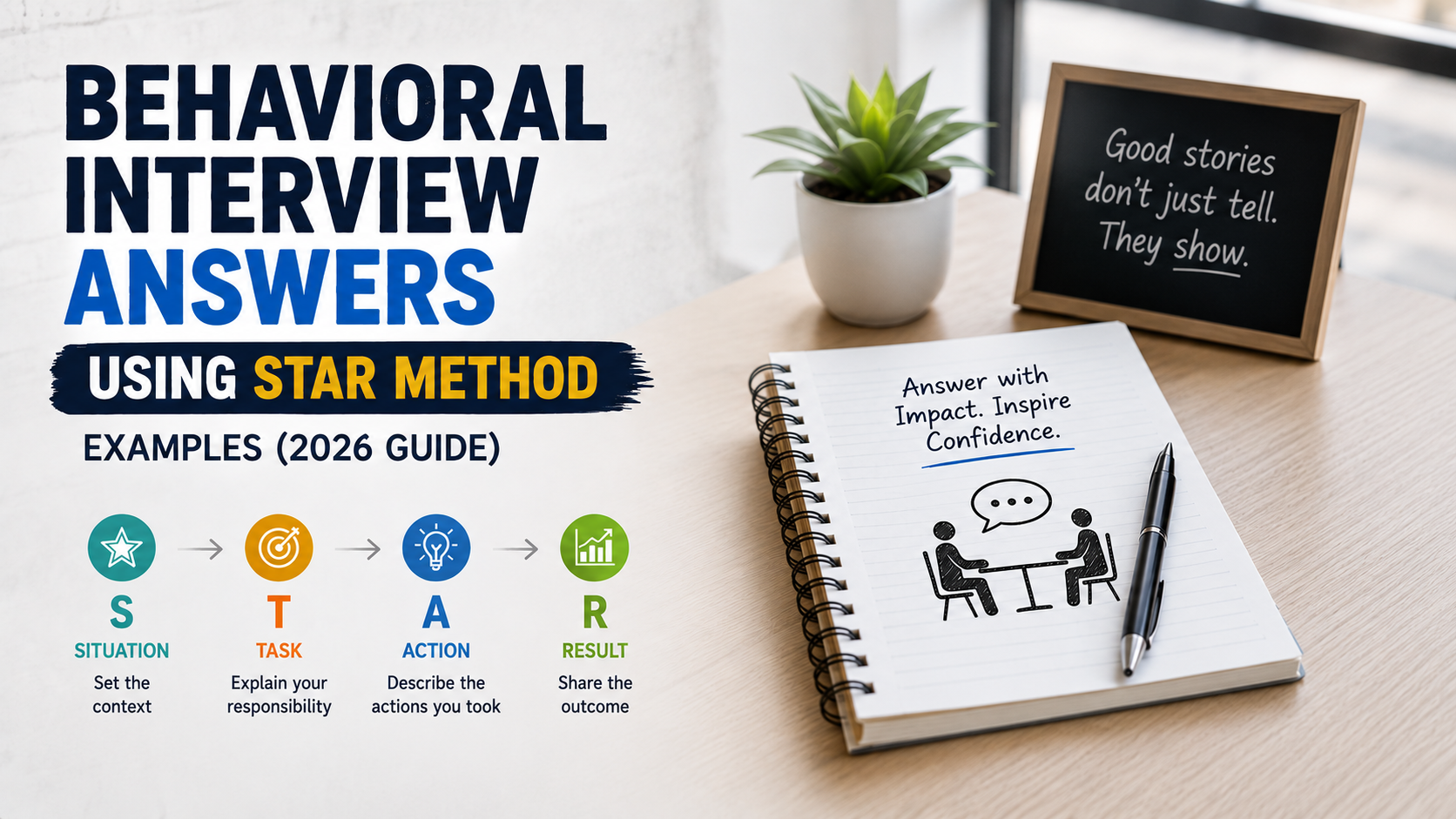
Behavioral Interview Answers Using STAR Method Examples (2026 Guide)
Master the STAR method for behavioral rounds in tech. Learn the scoring framework, access level-calibrated examples, and prepare high-scoring responses.
More from AllyNerds
Not directly related — other guides readers find useful.
How to Answer Tell Me About Yourself as a Software Engineer (2026 Guide)
Master the self introduction for technical interviews. Learn the Present-Past-Future framework, access role-specific templates, and impress recruiters, with examples

Meta Behavioral Interview Questions for Engineers 2026
Meta's behavioral round trips up more engineers than the coding rounds do. This covers the questions, what the Jedi round actually tests, and how Meta weights behavioral scores against technical performance in 2026.
Master the First Pass with a Clear Resume Review Guide
This overview explains the resume-review hub in practical terms. It covers why a clear, role-aligned resume matters, how a structured evaluation works, and concrete checkpoints to improve readability and ATS compatibility. You’ll also see common mistakes and a step-by-step approach to a before/after that makes the value tangible.

Rejected After Final Round Tech Interview? ,What Went Wrong?
Getting rejected after a final-round tech interview is brutal. Learn the hidden reasons why companies pass on strong candidates and how to recover