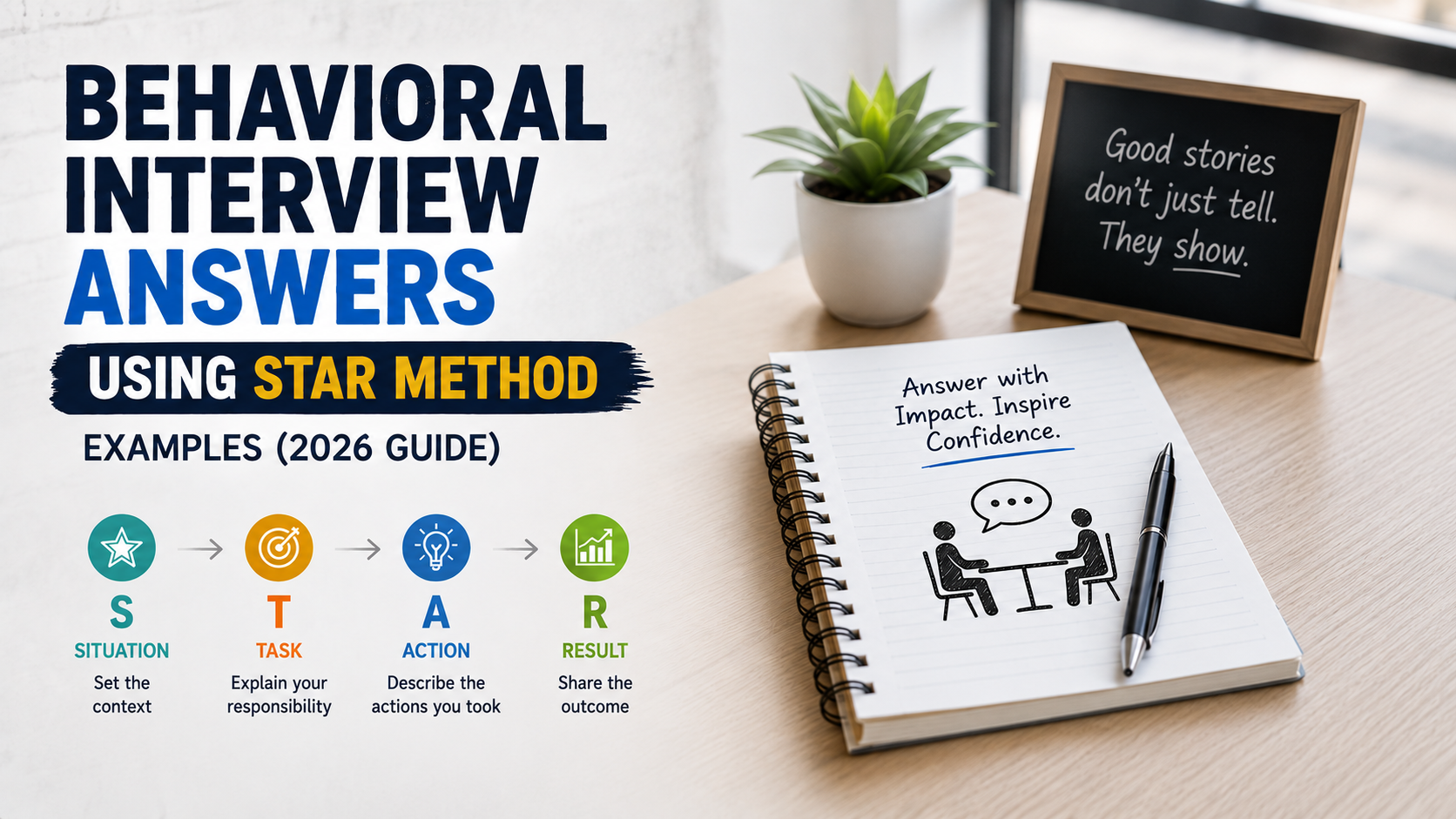
High scoring behavioral interview answers using STAR method examples 2026 rely on concrete metrics, individual decision-making, and structural communication. In 2026, tech companies score behavioral rounds using highly structured internal rubrics rather than casual observations. Your Situation, Task, Action, and Result (STAR) stories must isolate your specific contributions and prove you operate at the target engineering bar.
The Internal Mechanics of the STAR Framework
Most software developers believe the behavioral round is a formality. They assume they can charm their way through by describing a successful team project. This is a massive mistake.
When you tell a story, the interviewer is literally checking boxes on a scoring sheet. If your response is unstructured, you miss critical dimensions.
To earn max points, you must utilize the STAR method interview answers template 2026 structure:
Situation (10 percent of time): Define the business environment, scale, and specific challenge. Limit this to under three sentences.
Task (10 percent of time): Define the exact goal you were assigned or took upon yourself to resolve.
Action (60 percent of time): Detail the precise steps you took. Use "I" constantly to highlight individual ownership.
Result (20 percent of time): State the quantified business outcome. Vague results like "the team was happy" lead to a lower score.
If your story fails to prove your individual impact with metrics, it will be marked as a low signal.
Highly Calibrated STAR Examples for Tech Interviews
To stand out, your stories must address the core dimensions that tech companies score: conflict resolution, handling failure, and managing ambiguity.
Use these specialized behavioral interview STAR format examples as blueprints for your own story bank:
1. STAR Method Conflict Resolution Example
This template demonstrates professional maturity, stakeholder alignment, and data-driven negotiation:
Situation
At my last company, our lead frontend developer and I disagreed on our state management strategy for a new SaaS product dashboard. They wanted to use Redux to maintain consistency with legacy code, while I believed React Context was sufficient and would save two weeks of development time.
Task
My goal was to resolve the architectural conflict, maintain our tight four-week delivery timeline, and ensure a collaborative working relationship with my teammate.
Action
I did not argue my opinion; I built a rapid comparative prototype. I spent six hours setting up two sandbox environments comparing the boilerplate code size and state update latency of both approaches. I scheduled a thirty-minute meeting, presented the data showing React Context met all performance requirements with forty percent less codebase size, and listened to their concerns about future maintainability. I proposed a compromise: we would use React Context for the launch, but implement standard interfaces to allow an easy migration to Redux if system complexity tripled next year.
Result
My teammate agreed with the data-backed proposal, and we delivered the SaaS dashboard three days ahead of schedule. The codebase remained clean, and our collaboration improved significantly, leading to two subsequent successful product launches.
This is a premier STAR method conflict resolution example because it replaces emotional arguments with objective data and shows a clear win-win outcome.
2. Handling a Production Failure Example
This example demonstrates extreme ownership under high-pressure scenarios:
Situation
Ten minutes after deploying an API update on a Friday, our automated monitoring alerts indicated a sudden thirty percent spike in server memory usage on our transaction microservice, threatening a complete regional outage.
Task
As the On-Call Engineer, I had to immediately isolate the system failure, mitigate the active memory leak, and restore API transaction reliability.
Action
I did not panic. I immediately executed a rollback to our previous stable release, which restored memory levels within three minutes. I then set up a sandbox environment, reproduced the deployment package, and ran a memory profiler under simulated peak traffic. I located the root cause: an unclosed database cursor in a new logging middleware script. I refactored the middleware to ensure database connections closed within a try-finally block, deployed the patch to staging for extensive concurrency testing, and coordinated the production release the following Monday.
Result
The transaction service achieved one hundred percent uptime during subsequent traffic peaks. The memory footprint remained stable under high load, and I documented the incident and fix in a team post-mortem to prevent future occurrences.
This story highlights high-pressure execution and systemic learning, which are highly scored dimensions in senior engineering loops.

Photo by George Morina via Pexels
How Tech Companies Score Behavioral Answers in 2026
Behavioral scoring rubrics have shifted significantly in recent years. Companies look for specific cultural signals rather than just general competence:
1. Meta (The Jedi Round)
Meta evaluates how you navigate cross-functional relationships and operate at scale. They want to see that you influence decisions without having direct authority. Your stories must highlight how you aligned product managers, design leads, and engineering peers.
2. Google (Googleyness and Leadership)
Google scores you on how you handle ambiguity, support your team, and respect diverse working styles. Your answers must prove you are comfortable making decisions when specifications are forty percent complete, and that you prioritize team success over individual glory.
3. Amazon (Leadership Principles)
Amazon uses their sixteen LPs to grade every answer. They are obsessed with deep details and individual action. If you use the word "we" in your Amazon loop, the interviewer will interrupt you to ask what you did. Focus on your metrics and specific ownership.
Understanding these differences is key to delivering the best STAR answers for tech interviews.
Level Calibration: How STAR Stories Scale by Seniority
A common mistake candidates make is telling a junior-level story in a senior-level interview. Your story depth must match the level of the role you want:
Junior Developers (L3 / E3): Focus on execution speed, rapid learning, and following technical guidelines. The complexity is in the implementation itself.
Mid-Level Developers (L4 / E4): Focus on independent feature ownership, resolving minor technical disagreements, and managing small project timelines.
Senior Developers (L5 / E5): Focus on architectural trade-offs, stakeholder alignment, managing ambiguity, and mitigating risks. The code is secondary; the decision-making is primary.
Staff Developers (L6 / E6): Focus on cross-cutting organizational impact, defining multi-quarter technical strategies, and resolving deep structural conflicts between large engineering teams.
Before you walk into the room, audit your story bank. Ensure your milestones show the correct level of leverage.
The Multi-STAR Threading Strategy for Complex Loops
During a standard onsite loop, you face four to five different interviewers. If you tell entirely different stories to each one, you will need a massive story bank.
The strongest candidates use multi-STAR threading. This means you prepare eight to ten highly versatile stories that can answer multiple different questions depending on the angle.
For example, a story about a complex database migration under a tight deadline can highlight:
Leadership: How you organized the database mapping tasks.
Overcoming Setbacks: How you dealt with the database admin leaving mid-project.
Handling Ambiguity: How you managed migrating undocumented legacy schemas.
When constructing your STAR method practice questions and answers spreadsheet, map each of your stories to three potential interview prompts. This gives you massive flexibility during the live loop.
How to Get Started with Your Behavioral Prep
Do not try to wing the behavioral round. Preparing your stories is just as important as studying algorithms or system design.
Write down eight to ten versatile stories using our STAR method template. Make sure every result section has a concrete metric.
Research the company context and find recent candidate reports on AllyNerds before your onsite loop.
Practice delivering your stories out loud on AllyNerds. Use our recording and feedback tools to check your pacing, confirm you are staying under two minutes, and ensure you are providing a strong technical signal.
Start your career workflow on AllyNerds. Access our behavioral preparation modules to align your professional narrative with the role expectations.
Frequently Asked Questions
What is the most important part of the STAR method?
The Action section is the most critical component. It should comprise roughly sixty percent of your response. Focus entirely on what you personally decided, coded, or led. Vague explanations of team actions will lead to a lower score.
How long should a behavioral interview answer be?
Your response should last between ninety seconds and two minutes. Rambling beyond two minutes is a major red flag that indicates poor communication structure. Keep your present, past, and future sections concise and focused on high-level impact.
What should I do if my STAR story does not have a quantifiable result?
You must find a metric. If you did not measure the outcome at the time, estimate it using industry baselines. For example, if you automated a manual process, calculate the developer hours saved per month. Vague outcomes like "the project was successful" do not pass the technical bar.
Can I reuse the same STAR story with different interviewers?
No. Tech interviewers meet during a debrief session to review their notes. If they discover you used the same story twice, it indicates a lack of experience and a shallow story bank. Always use a fresh story for each interviewer.
How do I prepare behavioral answers if I have limited professional experience?
If you are a new grad or self-taught developer, draw stories from internships, capstone projects, open-source contributions, or hackathons. Focus on your rapid learning speed, how you resolved technical blockers, and your collaboration with peers.
How do I frame a story about a project that failed?
Frame the failure as a learning experience. Spend thirty percent of the time explaining what went wrong and seventy percent of the time detailing what you learned, how you adjusted your processes, and how that learning prevented similar failures in future projects.
Final Thoughts
Behavioral interviews in tech are not casual conversations; they are structured evaluations of your decision-making and professional maturity. The candidate who tells a clear, number-backed story using the STAR method beats the candidate who boasts about a massive but unmeasured project every time.
Build your story bank, write down your metrics, and practice the delivery. The room is challenging, but with the right structure, you can earn the offer. and mock interviewer with real time feed back with https://www.allynerds.com/edge