Technical Program Manager Interview Questions and Answers (2026 Guide)
Ace your next loop with our complete technical program manager interview questions and answers 2026 prep guide. Master system design, program sense, and behavioral rounds.
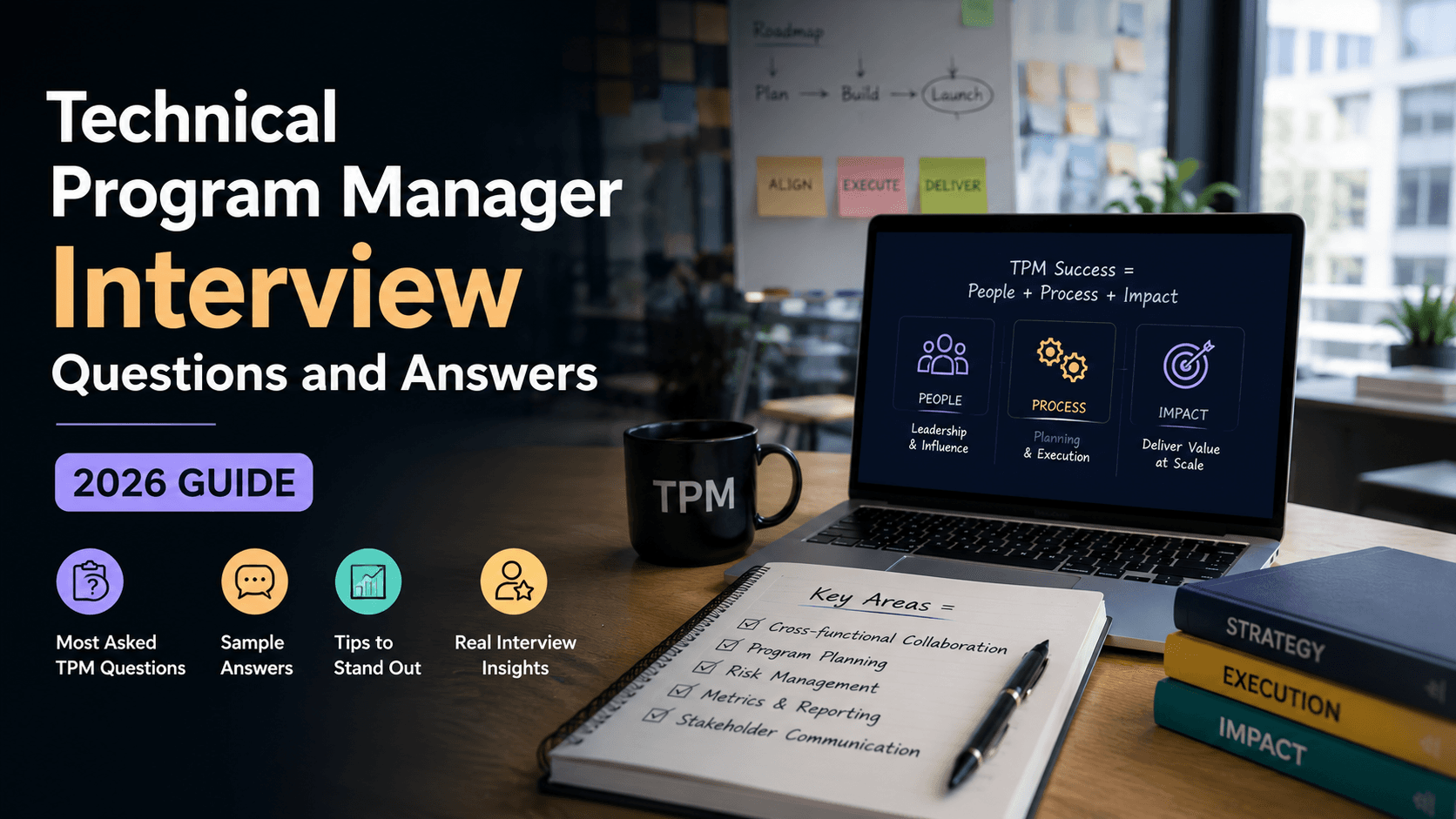
To ace a technical program manager interview in 2026, you must demonstrate strong technical architecture skills alongside solid program delivery frameworks. This means proving you can drive complex system migrations, define clear API contracts, and resolve cross-functional team conflicts without relying on authority, all while maintaining absolute clarity under pressure.
Why the TPM Role is a Different Beast
Let us be completely honest with ourselves for a brief second. Preparing for a technical program manager loop is uniquely exhausting because you are essentially preparing for two entirely different jobs at the same time. You need to be technical enough to argue with a principal software engineer about database sharding strategies, yet organized enough to explain dependency risk mitigation to a product director who thinks Kubernetes is a type of Swedish food.
If you prepare for this like a standard software development engineer, you will fail. If you prepare for it like a traditional project manager, you will also fail.
The industry has shifted dramatically. In 2026, companies are no longer hiring TPMs who merely act as expensive human calendar reminders. They want technical leaders who can read system architecture diagrams, spot dependency bottlenecks before they write a single line of code, and manage complex cross-functional programs with cold, structured precision. This guide covers the exact technical program manager interview questions and answers 2026 candidate pools are using to secure senior and staff offers at major tech hubs.

How the TPM Interview Structure Works
The standard loop is divided into three distinct pillars, each testing a specific dimension of your execution and architectural competency.
Pillar 1: Program Sense and Execution. This is where they test your ability to handle chaos. You will face questions about cross-team dependencies, late delivery mitigation, resource constraints, and conflicting priorities. The goal is to see if you have a structured methodology or if you just panic and send status emails.
Pillar 2: TPM System Design Interview Questions. You are not expected to write code on a whiteboard, but you must be able to design large-scale distributed systems. You need to discuss microservices scaling, caching strategies, API gateway patterns, and database replication trade-offs. The interviewer wants to see if you can lead technical discussions and understand the architectural impact of your program decisions.
Pillar 3: Behavioral and Leadership. This is where principles like ownership, bias for action, and earning trust are tested. At companies like Amazon, this is heavily focused on the core leadership guidelines. At Google, it is about Googleyness and leadership under ambiguity.
Let us break down each of these sections with real questions, calibrated templates, and high-scoring structures.
Mastering the Program Sense Round
In a traditional technical program manager program management round, the interviewer is looking for structure, scale, and metrics. If you answer a dependency question by saying, "I set up a weekly meeting to align everyone," you have already lost the room. Weekly meetings are not a strategy; they are a tax on everyone's calendar.
Instead, you must show a systematic approach to program health. Use the following question and structured answer template to frame your execution stories.
Question: "How do you handle a critical dependency team that suddenly informs you they will miss their delivery date by four weeks, threatening your entire launch timeline?"
How to Structure Your Answer:
Assess and Quantify: Immediately determine the actual critical path impact. Never take a delay at face value.
Mitigate and De-risk: Explore technical alternatives, such as feature flagging, stubbing APIs, or decoupling services to unblock your own team.
Negotiate and Re-scope: Work with the dependency team to deliver a minimum viable integration point rather than the full feature set.
Communicate with Data: Bring options, impact metrics, and trade-offs to stakeholders, never just a problem.
High-Scoring Response Template:
"When a critical dependency team informs me of a major delay, I follow a strict four-step triage process. First, I map the delay to our critical path to calculate the exact impact. In a recent cloud migration program, our data ingestion team announced a four-week delay. I immediately verified that this would push our global launch date out by twenty business days.
Second, I drove a technical mitigation workshop. Instead of waiting for their complete data validation service, we agreed on a temporary API contract schema. We stubbed the responses using mock data, which allowed our downstream application teams to continue development and testing without losing momentum.
Third, I negotiated a tiered delivery plan. The dependency team committed to delivering a simplified core endpoint in two weeks, delaying the advanced analytics dashboard to a post-launch phase.
Fourth, I presented three clear options to the steering committee: launch on time with a mock integration and limited analytics, delay the launch by four weeks to include full analytics, or reallocate two of our platform engineers to help the dependency team unblock their pipeline. By presenting options with quantified impact, we kept the program moving and launched on time with the core features fully operational."
Succeeding in TPM System Design Interview Questions
Do not fall into the trap of thinking system design is only for software engineers. In 2026, the TPM system design interview questions you face will focus heavily on system boundaries, data flow, operational readiness, and architectural trade-offs.
While an engineer focuses on the optimal database index or write-path optimization, a TPM must focus on scalability, service-level agreements, cost, and operational maintenance. You need to prove you can bridge the gap between business requirements and technical implementation.
Question: "Design a notification system that handles millions of push notifications, emails, and SMS alerts daily, ensuring high deliverability and system resilience."
Key Technical Trade-offs to Discuss:
Message Queuing: Discuss using Apache Kafka or RabbitMQ to decouple the ingestion API from the delivery workers, ensuring surges in notifications do not crash the system.
Database Selection: Explain why a NoSQL database like DynamoDB or Cassandra is suited for user notification preferences due to low-latency key-value lookups, while transactional logs are stored in a relational database for auditing.
Rate Limiting and Throttling: Highlight how rate-limiting algorithms, such as token bucket, prevent your system from spamming users or triggering carrier blocks.
Idempotency: Explain how using unique transaction IDs prevents users from receiving the same push notification multiple times when network retries occur.
TPM Focus Area:
"When designing this architecture, my primary focus is on decoupling, rate limiting, and failure isolation. I would place a highly scalable ingestion service behind an API gateway, which writes incoming notification requests directly to a partitioned message queue. This isolates the ingestion layer from the downstream delivery services.
To ensure system resilience, I would implement a dead-letter queue pattern. If a downstream SMS provider fails, the worker retries up to three times using exponential backoff. If it still fails, the message is routed to a dead-letter queue for offline analysis, preventing a single failing provider from clogging the primary worker pipeline.
From an operational standpoint, we must track key metrics: ingestion latency, delivery success rate, and carrier-specific drop rates. This architectural design ensures that even if our email provider suffers a massive outage, our push notification and SMS delivery channels remain completely unaffected."
Preparing for Google and Amazon TPM Loops
The interview experience diverges significantly when you look at the top tier tech companies. Understanding these differences is the best TPM interview preparation strategy you can employ.
How to Prepare for Google TPM Interview:
The Google loop is famously academic and deeply technical. They care immensely about system design, technical architectural depth, and handling ambiguity.
Expect the Unexpected: You will get vague system design prompts like "Design a system to monitor global traffic congestion."
Technical Deep Dives: Be ready to explain low-level details. If you mention using a load balancer, expect to be asked how the load balancer handles session affinity at the network layer.
Googleyness: Focus your behavioral answers on intellectual humility, thriving in ambiguous situations, and doing the right thing for the user.
Amazon TPM Leadership Principles Interview:
The Amazon loop is a behavioral marathon built entirely around the company's core guidelines. Every single question will map back to these principles, and your answers must be structured using the STAR method.
Customer Obsession: Explain how you fought for the customer experience, even when it meant delaying a technical launch to fix a latency issue.
Ownership: Show how you stepped up to fix a broken cross-team process that was not technically your responsibility.
Dive Deep: Prove you understand the underlying technology of your programs. If you managed a migration, you must know the database migration metrics and the fallback recovery steps.
Common Mistakes to Avoid
Sounding like a project coordinator. If you focus entirely on scheduling meetings, writing minutes, and updating Jira tickets, you will be rejected. You must highlight your technical contributions, architecture decisions, and strategic risk mitigation.
Rambling without a structure. Under stress, candidates tend to tell long, unstructured stories that lack a clear point. Always use structured frameworks like the STAR method for behavioral answers and the systematic triage model for program sense.
Faking technical knowledge. If you do not know how a technology works, admit it and explain how you would work with your engineering team to find the answer. Interviewers can instantly spot when a candidate is using empty technical jargon.
Overcomplicating the system design. Start with a simple, functional architecture first, then scale it up step by step as you discuss constraints. Do not jump straight to complex multi-region active-active databases in the first five minutes.
How to Get Started with Your Preparation
The secret to acing the TPM loop is moving away from passive reading and focusing on active practice. Reading system design blogs is helpful, but you must practice explaining these complex architectures out loud under time constraints.
Here is your immediate action plan to build real interview confidence:
Step 1: Select three complex technical programs you have led. Write them down using a strict STAR format, ensuring you highlight your technical contributions, quantitative metrics, and architectural trade-offs.
Step 2: Practice your system design delivery. Sketch out architectures on a digital whiteboard and explain your technical choices out loud. If you want targeted data to help structure your prep, you can use our tools to research the company before your interview.
Step 3: Perform realistic simulation. Find a peer or use an interactive platform to practice answering questions under stress. To evaluate your communication style and get detailed telemetry on your delivery, you can practice mock interviews with AI feedback.
Frequently Asked Questions
What is the main difference between a product manager and a technical program manager?
A product manager defines what features to build and why they matter to the business, focusing heavily on market fit and customer needs. A technical program manager focuses on how to build and execute those features, managing cross-functional technical dependencies, system architecture alignment, and program delivery.
Do TPMs need to write code in system design interviews?
No, TPMs are not typically required to write actual code or solve algorithmic challenges on a whiteboard. Instead, they are evaluated on their ability to design highly scalable distributed systems, define API contracts, analyze component trade-offs, and lead deep technical discussions with engineering teams.
How long should my behavioral stories be in a TPM interview?
Your behavioral stories should take between three and four minutes to explain. Focus on a brief situation setup, spend the majority of your time describing your specific technical and program actions, and close with clear, quantified business results.
What is the best way to prepare for a TPM system design round?
The best approach is to master core distributed system concepts, including load balancing, caching, database sharding, and messaging queues, and then practice designing real-world architectures while discussing cost, scalability, and operational metrics out loud.
Final Thoughts
The technical program manager loop is challenging because it demands a rare combination of deep technical understanding and exceptional execution skills. However, by structuring your preparation around clear architectural trade-offs, systematic program sense frameworks, and metrics-driven behavioral stories, you can stand out from the crowd. Focus your preparation on active, verbal practice, align your stories with the target company's culture, and treat every question as an opportunity to demonstrate your engineering leadership.
Keep reading
Related guides picked for this topic.
technical program manager meta salary - Meta
Compare Meta technical program manager pay: base, bonus, equity, and level bands by location in the US.

Role Freeze vs Rejection Ghosting: How to Tell the Difference
Candidates often confuse role freeze and rejection ghosting during job searches. This post explains how to identify each and what signals to watch for so you can navigate the waiting game better.
Stage-by-Stage Ghosting Probability in Hiring Processes
Candidates often wonder about the stage-by-stage ghosting probability during hiring. This post analyzes which interview stage has highest ghosting rate and where candidates get ghosted most to improve your job search strategy.

Agentic AI Engineer Interview Questions Guide 2026
Hiring for agentic AI engineers rose sharply in 2026. This guide covers agentic AI engineer interview questions, system-design prompts, tool-use evaluation, and a step-by-step practice plan so you can walk into interviews with clearer answers and less panic.

AI Engineer Interview Questions 2026: Complete Guide
Most candidates underprepare for AI roles. This guide on AI engineer interview questions 2026 covers the interview loop, RAG and evaluation design, prompt engineering, system trade-offs, and a 6-step prep plan so you can practice effectively before your next loop.

None: Why Practicing Without Research Fails | AllyNerds
Most candidates prepare answers without researching the company. This insight explains why None of that practice lands, shows where candidates lose points, and gives quick fixes so your mock interviews actually match the real thing.