
Practice Your Interview with an AI Mock Interviewer
Preparing for an interview should be more than reading questions and rehearsing answers in your head.
AllyNerds Practice helps you simulate realistic interview conversations for your target role, work through relevant questions, receive feedback on your responses, and improve through repeated practice.
Practice behavioral and technical interviews with an AI interview coach, review feedback on your answers, pacing, and delivery, and replay sessions to see where you can improve.
Practice realistic interviews. Get actionable feedback. Improve before the real interview.
The short version
What is AllyNerds Practice?
AllyNerds Practice is an AI mock interview platform for practicing behavioral, technical, and role-specific interviews before the real conversation.
Instead of giving you a list of questions to read, Practice helps you work through an interview as a conversation.
You can prepare around the role you are targeting, practice with a realistic interview panel, respond to questions, receive feedback, and use that feedback to improve your next attempt. AllyNerds currently supports behavioral and technical interview practice with real-time feedback and session replay.
Who it fits
Practice is useful when you:
- Have an interview coming up and want to rehearse before it.
- Know the company and role but are unsure what the conversation may feel like.
- Have prepared answers but have not practiced saying them under interview conditions.
- Struggle with structure, clarity, pacing, or communicating your experience.
- Want to prepare for behavioral, technical, or role-specific discussions.
- Keep reaching interviews but are unsure where your answers are falling short.
- Want to improve between interview rounds instead of starting preparation from scratch.
The problem
Stop practicing random interview questions
The goal is not to memorize the perfect response. The goal is to practice how you understand a question, structure your thinking, communicate your experience, handle follow-ups, and improve your response before the real interview.
A generic question can help you think. It cannot fully prepare you for the context in which that question is asked.
A behavioral question asked by a recruiter is different from one explored by a hiring manager. A technical discussion requires different reasoning from a leadership conversation. A product candidate, data engineer, analyst, marketer, operations professional, or software engineer should not prepare for the same interview in the same way.
That is why AllyNerds Practice is designed around role-specific and interview-specific preparation, not simply a large question bank.
Coverage
What can you practice with AllyNerds?
Four kinds of preparation, each shaped by the role you are actually interviewing for.
Behavioral interviews
Questions around your experience, decisions, ownership, leadership, conflict, failure, collaboration, ambiguity, and achievements — the situations behavioral rounds actually explore.
Technical interviews
Technical reasoning, problem decomposition, engineering discussion, and technical decision-making relevant to your target role. The objective is not just reaching an answer; it is explaining your reasoning while an interviewer evaluates it.
Role-specific interviews
A product manager explains prioritization, a data engineer explains architecture and trade-offs, an analyst reasons through data and business problems. Preparation moves closer to the role instead of treating every candidate the same.
Interviewer-style conversations
Who asks the question matters. Practice against a realistic company interview panel so you rehearse the interaction itself, not only the written answer.
Behavioral rounds
What a behavioral session works on
- Structuring your stories clearly
- Explaining your individual contribution
- Providing enough context without overexplaining
- Connecting actions to measurable outcomes
- Handling follow-up questions
- Communicating ownership and decision-making
- Keeping answers focused on what the interviewer asked
Tracks
Preparation across professional tracks
Different jobs are evaluated differently, so preparation is shaped by the track you are interviewing into. AllyNerds supports preparation across:
- Engineering
- AI and Machine Learning
- Data
- Product
- Analytics
- Finance
- Healthcare
- Retail
- Operations
- Marketing
- Consulting
- Supply Chain
- Design
How it works
How AllyNerds Practice works
Practice, feedback, review, improve, practice again.
Start with your target interview
Begin with the company, role, or interview context you are preparing for. The more specific your preparation is, the easier it becomes to focus on questions that are relevant to your situation.
Set up your interview practice
Prepare the kind of interview conversation you want to rehearse. Rather than jumping between random questions, use the session to practice a specific interview context or area you want to improve.
Answer the questions
Respond as you would during the real interview. Do not aim for a memorized script — explain your thinking, tell your stories, make decisions, work through uncertainty, and communicate naturally. That is where practice becomes useful.
Get feedback on your performance
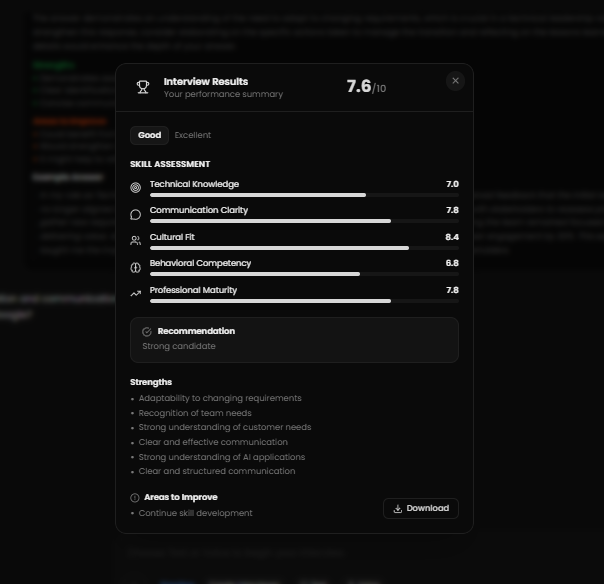
After answering, use the feedback to understand how your response came across. Practice provides feedback on your answers, pacing, and delivery, so you finish with specific signals rather than wondering whether you did well.
Review the session
Replay the session and look at the moments where your response became unclear, too long, rushed, incomplete, or less convincing than you intended. Seeing your own performance reveals things that are hard to notice while answering.
Practice again
The first attempt gives you information. The next attempt is where improvement begins. Use the feedback from one session to make the next response clearer, more structured, and more relevant.
The loop
The practice loop
Turn each interview attempt into a repeatable cycle of feedback and improvement.
- Practice
- Feedback
- Review
- Improve
- Practice again
Evaluation
What does AllyNerds evaluate?
Interview performance is not simply about whether an answer is technically correct. A strong response also has to communicate your thinking. Depending on the question and context, your review can help you think about:
Answer quality
Did you actually answer what was asked?
Structure
Was your response easy to follow, or did the main point get buried?
Relevance
Did you focus on information that mattered to the interviewer?
Communication
Did you explain your thinking clearly?
Pacing and delivery
Was the answer rushed, hesitant, unnecessarily long, or difficult to follow?
Evidence
Did you support your claims with specific actions, examples, decisions, or outcomes?
Improvement
What should you change when you answer a similar question again?
The real gap
From knowing your answer to delivering it
Reading an interview guide can help you understand what a good response looks like. Writing an answer can help you organize your thoughts. But an interview requires you to produce that answer in a live conversation, and that is a different skill.
You have to recall the right example, decide what matters, organize your response, communicate clearly, react to follow-up questions, and do all of it without sounding like you are reading a script.
Practice gives you a place to work on that skill before the interview matters.
The order that works
Research first. Practice with context.
Practice becomes more useful when you understand what you are preparing for. Use AllyNerds Research to understand the company, role, interview expectations, and relevant context — then move into Practice.
- Research the company and role
- Understand what the interview may evaluate
- Identify what you need to prepare
- Practice relevant interview conversations
- Review your feedback
- Improve weak answers
- Prepare for the real interview
Start where you are
Still working out what the interview will test? Start with Research. Already know? Go straight to Practice.
The difference
AllyNerds Practice vs random interview questions
Random interview questions
That can help with familiarity, but it does not recreate the pressure or flow of explaining your answer to an interviewer.
- You find a list
- You read the question
- You think about an answer
- You move to the next question
AllyNerds Practice
- You prepare for an interview context
- You answer as part of a realistic conversation
- You receive feedback
- You review the session
- You identify what needs work
- You practice again
The difference is not more questions. It is a better practice loop.
A fair question
Why not just ask ChatGPT for interview questions?
General AI tools are useful for brainstorming questions, explaining concepts, or helping you think through an answer. AllyNerds Practice is built specifically around the interview-preparation workflow.
Instead of starting a new prompt every time you want another question, the goal is to connect your target role, the interview context, the practice itself, the evaluation, the feedback, and the improvement into one loop.
Use general AI when you need general assistance. Use AllyNerds Practice when you want a dedicated environment for rehearsing an interview and improving how you perform in it.
Why rehearse
Why practice before the real interview?
Most weaknesses are easier to fix when you discover them before someone is deciding whether to hire you. Practice can expose problems such as:
- Giving a five-minute answer to a question that needed two minutes
- Providing context without explaining your contribution
- Describing responsibilities instead of impact
- Starting an answer without a clear structure
- Knowing the technical concept but struggling to explain it
- Forgetting the outcome of a story
- Using the same example for every behavioral question
- Sounding memorized rather than conversational
- Failing to explain why you made a particular decision
- Finishing an answer without connecting it to the question
Where it sits
Built for real interview preparation
AllyNerds Practice is part of a broader preparation system designed to help candidates research companies, understand roles, evaluate fit, and practice interviews rather than prepare through disconnected tools.
The Practice experience currently includes AI-powered mock interviews, behavioral and technical interview practice, feedback, coaching, and session replay.
A note about AI feedback
AllyNerds Practice uses AI to support interview simulation and feedback. AI feedback should be used as preparation guidance, not as a prediction of a company's hiring decision.
Companies, teams, interviewers, questions, and evaluation criteria vary. No preparation platform can know every question an interviewer will ask or guarantee an interview outcome. The purpose of Practice is to help you walk into that uncertainty better prepared.
The product
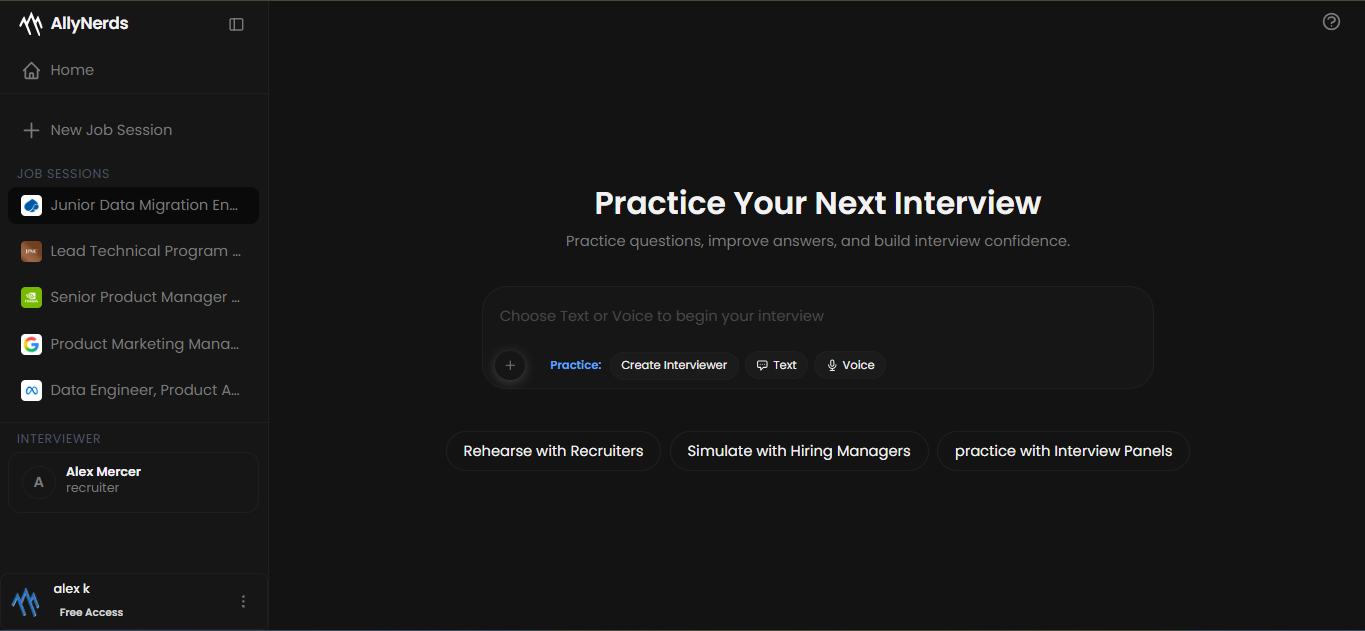
See what Practice looks like
The real interface, not an illustration of it.
Fit
Who is AllyNerds Practice for?
Preparing for your first interview
Get comfortable answering questions aloud and structuring your responses before it counts.
Already getting interviews
Focus preparation on the specific role and interview you actually have coming up.
Reaching later rounds without offers
Use repeated sessions to find patterns in your communication, stories, reasoning, or delivery.
Preparing for a technical role
Practice explaining your reasoning out loud instead of only solving problems privately.
Preparing for a non-technical role
Rehearse behavioral, situational, and decision-making conversations relevant to your work.
Changing industries or roles
Improve how you connect existing experience to what the new role actually requires.
The point
Do not memorize the interview. Prepare for it.
Research what you are walking into. Practice how you will respond. Review what needs work. Improve before the real conversation.
You cannot know exactly what an interviewer will ask, and you do not need to.
Good preparation means understanding the role, recognizing the kinds of situations you may face, organizing your strongest evidence, and becoming comfortable explaining your thinking when the wording changes.
Testimonials
Here is what users are saying about AllyNerds

Talked about practice tool about AllyNerds.
AllyNerds' practice tool gave me real interview experience without the pressure. The structured mocks and instant feedback boosted my confidence a lot.
Your next interview should not be your first practice run
You already know what role you want. Now practice communicating why you are ready for it. Run a realistic mock interview, answer the questions out loud, review your feedback, and improve before the real conversation begins.
FAQ
Frequently asked questions
What candidates ask before their first session.
What is AllyNerds Practice?
AllyNerds Practice is an AI-powered interview-practice experience that helps candidates run realistic mock interviews, answer interview questions, receive feedback, and improve through repeated practice.
What types of interviews can I practice?
AllyNerds currently supports behavioral and technical interview practice, alongside role-specific preparation and technical or non-technical discussion simulations across its interview-preparation workflows.
Does AllyNerds give feedback on my answers?
Yes. The Practice experience provides real-time feedback on answers, pacing, and delivery, along with personalized response analysis.
Can I replay a mock interview?
Yes. Session replay is included in the current AllyNerds Practice experience, so you can review your performance after practicing.
Are the questions specific to my role?
AllyNerds is designed around personalized preparation for a candidate's role, target company, and interview format rather than a one-size-fits-all preparation flow.
Can I practice behavioral interview questions?
Yes. Behavioral interview practice is one of the core interview-practice capabilities currently offered by AllyNerds.
Can I practice technical interviews?
Yes. AllyNerds currently supports technical interview practice and also supports technical discussion simulations within its role-specific preparation system.
Is this just a question bank?
No. The purpose of Practice is to create a practice-and-improvement loop: answer questions in an interview setting, receive feedback, review your performance, and use what you learned in your next session.
Should I use Research or Practice first?
If you already understand the company, role, and interview you are preparing for, you can move directly into Practice. If you are still unsure what the company may evaluate or what you should prepare, start with Research and use that context to guide your mock interviews.
Does AllyNerds know the exact questions I will be asked?
No. Interview questions and evaluation criteria vary by company, team, interviewer, and individual interview. AllyNerds is a preparation tool designed to help you practice relevant interview situations and improve your responses, not to predict an exact future interview.
Can AllyNerds guarantee that I will pass my interview?
No preparation platform can guarantee a hiring outcome. AllyNerds helps you prepare more deliberately by giving you a place to practice, evaluate your responses, identify weaknesses, and improve before the interview.
Reading about it is not the same as doing it.