
Know What You Are Walking Into Before the Interview
An interview is easier to prepare for when you understand the company, the role, and what the conversation is likely to focus on.
AllyNerds Research brings the information you need for interview preparation into one structured workspace — so you can understand the company, explore your target role, research interview context, identify important skills, and decide what to prepare next.
Stop opening dozens of tabs and trying to turn scattered information into an interview plan.
Research the company. Understand the role. Know what to prepare.
The short version
What is AllyNerds Research?
AllyNerds Research is a company and role research workspace built specifically for interview preparation.
It helps you move beyond basic questions such as "who is this company?" and toward the questions that actually affect your interview.
The goal is simple: turn company information into interview preparation.
The questions that matter
What Research helps you answer
- What does this company do?
- What matters to the business?
- What should I know about this role?
- What skills appear important?
- What could interviewers evaluate?
- What does the interview process look like?
- Who might I speak with?
- What should I research before the conversation?
- What should I practice afterward?
The company
Start by understanding the company itself
Research should help you build enough context to speak intelligently about the organization instead of memorizing its About page. Explore information such as:
- What the company does
- Products and services
- Industry and market
- Business model
- Customers
- Company size and presence
- Important business areas
- Company culture and working environment
- Recent developments relevant to candidates
- Information that may help answer "why this company?"
The role
Understand the role you are interviewing for
The goal is not to memorize company facts. It is to understand enough context to connect your experience and motivation to the company you are interviewing with.
A job title alone rarely tells you everything an interviewer wants. Two companies hiring for a Data Engineer, Product Manager, Business Analyst, or Operations Manager may expect very different things.
AllyNerds Research helps you investigate the role in the context of the company. That gives you something much more useful than a job description copied into your notes — it gives you a preparation direction.
Role analysis
What to look for in the role
Role responsibilities
What is this person expected to own?
Important skills
Which technical, business, communication, leadership, or domain skills appear most relevant?
Tools and technologies
What tools, platforms, frameworks, or systems are connected to the role?
Experience expectations
What previous work or knowledge appears important?
Business context
Where does the role sit within the larger organization?
Success in the role
What problems would someone in this position likely be expected to solve?
The process
Research the interview process
Knowing the job is only one part of preparing. You also need to understand how the company may evaluate candidates. Research the available information around:
- Recruiter screening
- Hiring manager conversations
- Behavioral interviews
- Technical interviews
- Case or scenario rounds
- Role-specific discussions
- Panel interviews
- Final rounds
- Interview sequence
- Skills commonly assessed at different stages
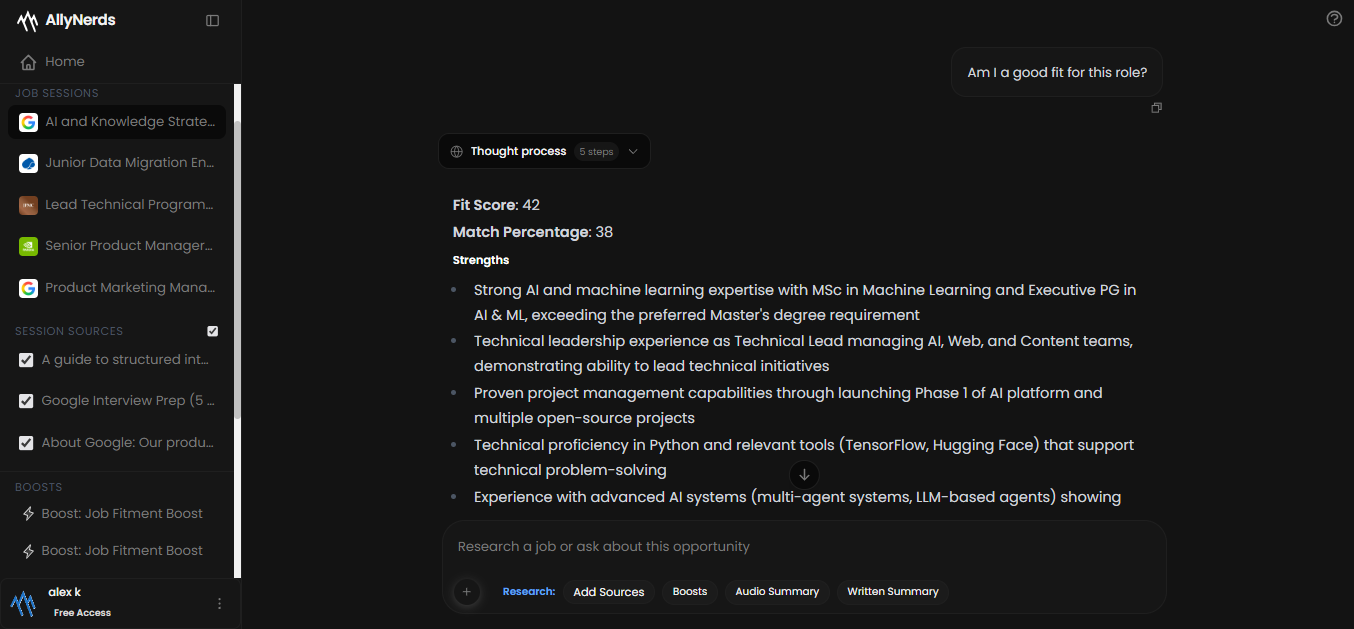
The people
Understand who may be interviewing you
The same answer can be evaluated differently depending on who is listening. A recruiter may care about your motivation and basic fit. A hiring manager may dig deeper into your experience and ownership. A technical interviewer may want to understand how you think through problems. A senior leader may focus more heavily on judgment, impact, communication, or strategic thinking.
Where relevant information is available, research the people or interviewer types connected to your interview so you can better understand the conversation you are preparing for.
Use interviewer research to understand professional context — not to memorize personal details or manufacture artificial familiarity.
Prioritise
Identify the skills that matter
One of the most useful outcomes of research is knowing where to spend your preparation time. Instead of trying to prepare everything, identify the skills most relevant to your target role. These may include:
- Technical knowledge
- Problem solving
- Data analysis
- System design
- Product thinking
- Business judgment
- Communication
- Leadership
- Collaboration
- Stakeholder management
- Customer thinking
- Domain expertise
- Execution
- Decision-making
- Role-specific tools and technologies
Then ask
Three questions that make research actionable
Answer those three and research has stopped being reading. It has become a preparation plan.
Which of these can I already demonstrate well?
Which need stronger examples?
Which need more practice before my interview?
Worked examples
From job description to interview preparation
A job description tells you what the company says it wants. Research turns each line into the question you actually have to answer.
- "Work cross-functionally with product and engineering teams"
- What example proves I can influence and execute across teams?
- "Design scalable data pipelines"
- Can I clearly explain a pipeline I designed, the trade-offs I considered, and the impact it created?
- "Operate effectively in ambiguous environments"
- Which experience best demonstrates how I made decisions without complete information?
How it works
How AllyNerds Research works
Your preparation should begin with context, not a generic list of interview questions.
Choose your target company and role
Start with the interview or opportunity you care about, rather than with a question bank that knows nothing about it.
Understand the company
Learn what the company does, where your role fits, and which parts of the business may matter for your conversation.
Understand the role
Break the position into responsibilities, skills, experience expectations, tools, and business impact.
Explore the interview context
Understand the available information around interview stages, formats, interviewer types, and the areas candidates may be evaluated on.
Identify what matters most
Connect company context, role expectations, and interview information. What should I know? What should I be able to explain? Which experiences should I prepare? Where am I less prepared?
Turn research into practice
Research should end with action. Take what you learned and move directly into interview practice.
The path
Research ends where practice begins
- Company
- Role
- Skills
- Interview expectations
- Preparation priorities
- Mock interview
- Feedback
- Improvement
The checklist
Research should answer more than "what does this company do?"
Before your interview, you should be able to answer four groups of questions. When Research answers these, it has become preparation rather than browsing.
About the company
What does the company actually do? Who does it serve? What products or services matter? What is happening in the business? Why does this company interest me?
About the role
What will I probably be responsible for? What problems would I be expected to solve? What skills appear most important? Which parts of my experience match those expectations?
About the interview
What interview stages may exist? What types of conversations should I prepare for? What competencies may be evaluated? Who might evaluate different parts of my experience?
About yourself
Which of my experiences should I discuss? Where am I strongest? Where could an interviewer challenge me? What do I need to practice?
The difference
Why not just Google the company?
Google is useful when you know exactly what you are looking for. Interview research is usually the case where you do not.
Searching it yourself
And eventually: "okay, but what should I actually prepare?"
- Company website
- LinkedIn, then the job description
- News articles, Glassdoor, Reddit
- Interview guides and more search results
- More tabs, more notes
AllyNerds Research
- Research stays attached to one company and role
- Information is weighted by what affects your interview
- Role, skills, and interview context stay connected
- You leave with preparation priorities, not a reading list
Google helps you find information. AllyNerds helps you organize your interview research around what you need to prepare.
A fair question
Why not just ask ChatGPT?
A general AI assistant can summarize a company or answer individual questions. But interview research involves more than generating a company summary.
You need to connect company context, role expectations, skills, the interview process, interviewer context, and your own preparation priorities — and keep them connected across a week of preparation rather than restarting from an empty prompt each time.
Use general AI when you need a general answer. Use AllyNerds Research when the objective is: help me understand this opportunity well enough to prepare for the interview.
The order
Research before you practice
Research tells you what matters. Practice helps you get better at communicating it.
Going directly into mock interviews can feel productive. But if you are practicing the wrong things, repetition does not solve the problem. Research gives your practice direction.
Instead of "give me Product Manager interview questions", you can prepare around a target company, its role expectations, the interview stage, and the skills actually being evaluated.
Instead of "give me behavioral questions", you can identify that leadership, stakeholder management, and ambiguity appear important — so you need strong examples in exactly those areas.
Start where you are
Research first if you are still working out what the interview will test. Go straight to Practice if you already know and need to rehearse saying it.
The output
Turn research into a preparation plan
After researching a company and role, you should leave with clear preparation priorities.
Know
What company and role context should you understand before the interview?
Prepare
Which experiences, projects, achievements, and examples should you be ready to discuss?
Review
Which technical, business, or domain concepts deserve additional preparation?
Practice
Which interview conversations should you simulate?
Improve
What weaknesses appear when you start answering those questions?
The loop
A continuous preparation loop
- Research
- Prioritize
- Practice
- Review
- Improve
Evidence
Research with evidence, not guesswork
Interview information goes stale quickly. Companies change teams. Job requirements change. Interview processes evolve. Compensation changes. Leadership changes. Candidate experiences differ from one another.
That is why research quality matters more than research volume. Important claims should not rest on one anonymous post when stronger sources exist, and where an exact interview process cannot be verified, the honest answer is to say so rather than present an estimate as a guarantee.
Trust comes from being clear about what is known, what is inferred, and what may vary.
Sources
What sources should research use?
For company and role research, prioritize high-quality sources such as:
- Official company websites
- Official careers pages
- Published job descriptions
- Investor relations material
- Regulatory filings when relevant
- Company engineering or product blogs
- Official leadership information
- Company announcements
- Reputable reporting
- Public professional profiles
- Candidate-reported interview experiences as supporting evidence
Interview information changes
No research platform can guarantee the exact interview process you will experience. A company's process may vary by role, seniority, team, location, interviewer, hiring manager, business unit, and hiring cycle.
Not every source has equal authority. Official information should generally establish company facts; candidate experiences provide useful interview context, but an individual experience should not be treated as universal. Research should help you understand the available evidence and likely preparation areas, not create false certainty.
The product
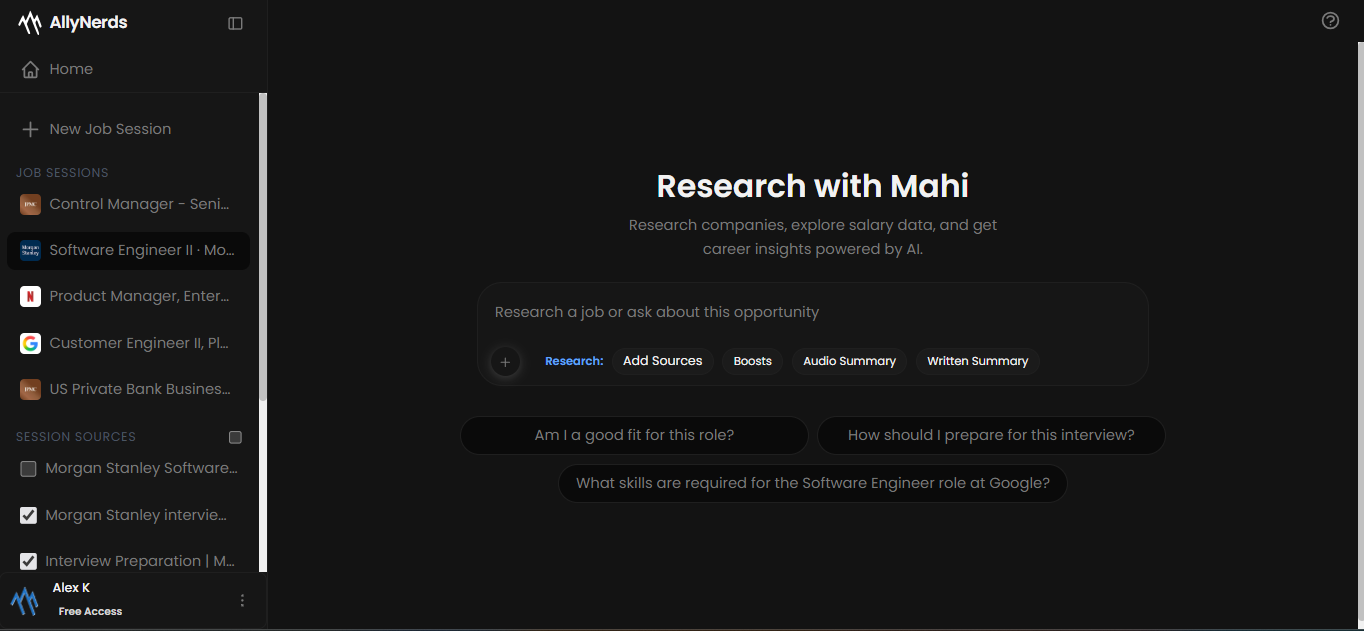
See what AllyNerds Research looks like
The real workspace, not an illustration of it.
Fit
Who is AllyNerds Research for?
You have an interview scheduled
Research the company and role before deciding what to practice.
You just received a recruiter call
Understand the opportunity before your first conversation.
You are preparing for a later round
Research what may change between recruiter, hiring manager, technical, behavioral, and final-stage conversations.
The company is unfamiliar
Build company and business context quickly, from sources that are worth trusting.
You are changing roles or industries
Understand what the target position expects and where your existing experience connects.
You have too much information
Turn scattered research into clear preparation priorities.
The outcome
What research should help you do
The purpose of Research is not to make you an expert on every fact about a company. You should leave better able to:
- Explain why the company interests you
- Understand what the role requires
- Recognize the skills likely to matter
- Choose relevant examples from your experience
- Understand the interview context
- Identify gaps in your preparation
- Ask stronger questions during the interview
- Decide what to practice next
End to end
From research to interview readiness
Research is the beginning of the preparation process, not the end.
- Research the company
- Research the role
- Identify important skills
- Understand the interview
- Identify your gaps
- Practice
- Get feedback
- Improve
The point
Do not research more. Research what matters.
Research every company. Practice every round. Land the role you actually want.
You do not need fifty browser tabs before your interview. You need to understand who you are interviewing with, what the role expects, what the company cares about, what the interview may evaluate, and what you need to prepare.
AllyNerds helps turn that information into your next action.
Testimonials
Here is what users are saying about AllyNerds

Talked about research tool about AllyNerds.
AllyNerds' research tool gave me structured, accurate, and up-to-date information that made my interview preparation way more efficient.
Start your research
Open a session for the job you are interviewing for and spend your preparation time deciding what to say, rather than collecting things to read.
FAQ
Frequently asked questions
What candidates ask before their first research session.
What is AllyNerds Research?
AllyNerds Research is a company and role research experience designed around interview preparation. It helps candidates understand their target company, role, relevant skills, interview context, and what they should prepare next.
What can I research on AllyNerds?
You can use Research to investigate the company and role you are targeting and build context for your interview preparation, including information relevant to the role, skills, interview process, and interviewer context where available.
Can I research a company before applying?
Yes. Company and role research can also help you determine whether an opportunity deserves further attention before you begin deeper interview preparation.
Can AllyNerds tell me the exact questions I will be asked?
No. Interview questions vary by interviewer, team, role, level, and interview cycle. Research should help you understand the areas you may need to prepare rather than pretend to predict an exact future interview.
Does every company use the same interview process?
No. Interview processes can vary significantly between companies and even between teams within the same company.
Why should I research my interviewer?
Understanding an interviewer's professional context can help you understand the type of conversation you may be entering. It should be used to prepare relevant communication — not to investigate unnecessary personal information.
Should I use Research before Practice?
For most targeted interview preparation, yes. Research gives you context about the company, role, skills, and interview. Practice then helps you rehearse how you will communicate during those conversations.
Is AllyNerds Research the same as Google?
No. Search engines are designed to retrieve information from across the web. AllyNerds Research is designed around the interview-preparation workflow: understanding the company and role, identifying relevant interview context, and turning that research into preparation.
Is AllyNerds Research the same as ChatGPT?
No. General AI can answer individual questions and generate summaries. AllyNerds Research is designed specifically around company, role, and interview preparation, and connects that research with the broader AllyNerds preparation workflow.
How current is the research?
Company and interview information can change. Treat anything time-sensitive — compensation, headcount, a recent reorganisation, the exact shape of a loop — as a starting point to confirm with your recruiter rather than as settled fact.
What should I do after completing Research?
Identify the areas most relevant to your interview and move into Practice. Use your research to determine which questions, skills, experiences, and conversations deserve your attention.
Reading about it is not the same as doing it.